
Introduction
Understand the fundamental need for identification, rules of binomial nomenclature, and the principles of taxonomy and systematics.
Need for Identification of Organisms
Different regions and languages often use different local names for the same plant or animal, which can lead to confusion. To avoid this, every organism must be accurately identified and scientifically described so that it is recognized by the same identity worldwide. This process of recognizing and distinguishing an organism based on its characteristics is known as identification.
Nomenclature
Nomenclature is the system of assigning standardized scientific names to living organisms so that each organism is recognized by the same name worldwide. An organism can be given a scientific name only after it has been correctly identified.
Scientific Names and International Codes
To ensure uniformity in naming, biologists follow internationally accepted rules while assigning scientific names to organisms. These rules are established through the following international codes:
- ICBN (International Code of Botanical Nomenclature):Provides the principles and rules for naming plants.
- ICZN (International Code of Zoological Nomenclature):Establishes the rules for naming animals.
- These international codes ensure that each organism has a unique scientific name and that the same name is not assigned to any other known organism, allowing scientists around the world to communicate accurately and consistently.
Binomial Nomenclature
Binomial nomenclature is the scientific system of naming organisms developed by Carolus Linnaeus. In this system, every organism is assigned a two-word scientific name consisting of the generic name (genus) and the specific epithet (species). This standardized naming system is followed by biologists worldwide.
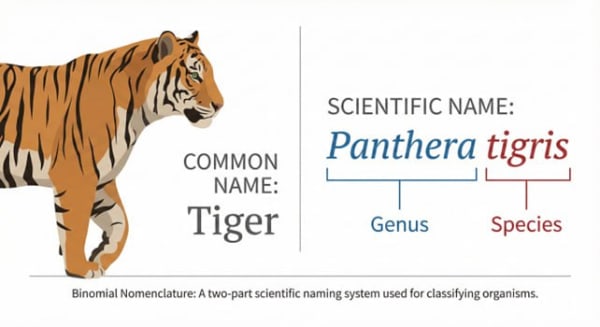
Binomial Nomenclature: A two-part scientific naming system (Genus + Species) used for classifying organisms.
Standard Examples
- Mangifera indicaMango
- Solanum tuberosumPotato
- Homo sapiensHuman
Key Works by Carolus Linnaeus
- Species Plantarum (1753)5,900 plant species
- Systema Naturae (1758)4,326 animal species
- Recognized universally as the “Father of Taxonomy”
Rules of Binomial Nomenclature
The scientific naming of organisms follows a set of internationally accepted rules:
- Latin Origin:Scientific names are generally Latin or Latinized and are written in italics, regardless of their original language.
- Two Components:A scientific name consists of two words — the first word represents the genus (generic name), and the second word represents the specific epithet.
- Format:When printed, scientific names are written in italics. When handwritten, each word is underlined separately.
- Capitalization:The genus name begins with a capital letter. The specific epithet begins with a small letter. Example: Mangifera indica.
- Author Citation:The abbreviated name of the scientist who first described the species is written after the scientific name. Example: Mangifera indica Linn.
Classification
Since it is impossible to study every living organism individually, scientists classify organisms into groups based on their observable similarities and differences. This process makes the study of the vast diversity of life more systematic, organized, and easier to understand.
Taxa and Taxon
The categories used in biological classification are called taxa (singular: taxon). A taxon represents a unit or rank of classification. Different taxa exist at different hierarchical levels. For example, Animalia, Mammalia, and Canis are all taxa, but each represents a different level in the classification hierarchy.
Taxonomy & Systematics
Taxonomy is the branch of biology concerned with the identification, characterization, nomenclature, and classification of living organisms. Organisms are classified into different taxa based on their characteristics.
- Modern taxonomy uses information from:External morphology, Internal anatomy, Cell structure, Developmental (embryological) features, and Ecological characteristics.
- The four basic processes of taxonomy are:Characterization, Identification, Classification, and Nomenclature.
Four Core Processes of Taxonomy
Characterization
Understanding the morphological and anatomical traits.
Identification
Determining the exact identity and distinct position.
Classification
Grouping into hierarchical categories based on similarities.
Nomenclature
Assigning standardized binomial scientific names.
Taxonomy
The scientific discipline concerned with the identification, naming, and classification of living organisms into hierarchically structured taxa.
Systematics
Derived from the Latin word systema. Includes taxonomy plus the comprehensive study of evolutionary (phylogenetic) relationships among organisms.