
Module 1 of 9
Taxonomy & Classification
Amphibian classification, poikilothermic nature, camouflage, and seasonal dormancy.
Systematic Position of Rana tigrina
Rana tigrina (Indian Bullfrog) is a cold-blooded (poikilothermic) amphibious vertebrate found in freshwater ponds and moist land.
Undergoes camouflage (mimicry) to blend with surroundings and escapes extreme temperatures via aestivation (summer sleep) and hibernation (winter sleep).
Anatomical Illustration / Diagram
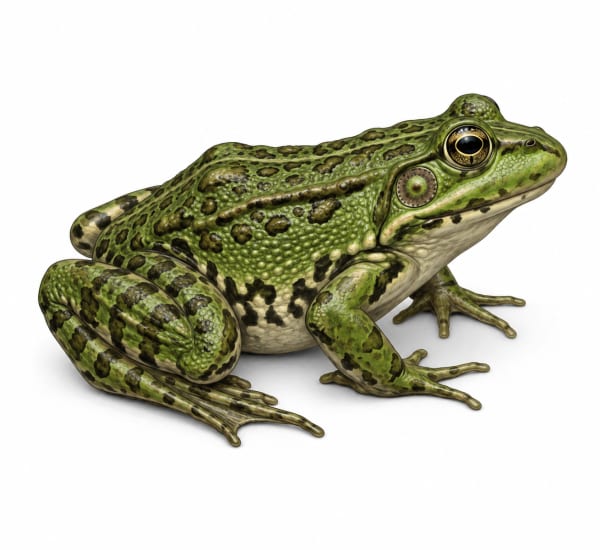
Figure: Rana tigrina (Indian Bullfrog)
| Taxonomic Rank | Classification | Key Characteristic |
|---|---|---|
| Kingdom | Animalia | Multicellular heterotrophic organisms |
| Phylum | Chordata | Notochord, dorsal nerve cord, pharyngeal gill slits |
| Class | Amphibia | Dual life (aquatic & terrestrial), scaleless moist skin |
| Order | Anura | Tailless adults, webbed hindlimbs |
| Genus | Rana | True frogs |
| Species | tigrina | Indian bullfrog |
Habitat & Adaptive Features
As an amphibian, Rana tigrina can live both on land and in freshwater habitats. It is commonly found near freshwater bodies such as ponds, lakes, and streams.
The skin of Rana tigrina is always moist and slippery due to the secretion of mucus. Frogs do not drink water directly — they absorb water through their highly vascularized skin.
- Cold-blooded (poikilothermic): Body temperature changes according to the surrounding environment.
- Aestivation: Buries itself in moist soil during hot and dry periods.
- Hibernation: Enters dormancy during cold conditions; respiration mainly through skin.
- Tadpole larva: In early life stage, lives entirely in water and breathes through gills.