
Introduction & Hierarchy
Discover the architectural hierarchy of animal life from single cells to complex organ systems and understand the 4 primary tissue lineages.
The Hierarchy of Animal Life: Cells to Systems
The animal kingdom shows a vast diversity of organisms, ranging from unicellular organisms to highly complex multicellular animals. In unicellular organisms, all essential life processes such as digestion, respiration, and reproduction are carried out by a single cell.
In contrast, multicellular animals have different groups of cells specialized to perform different functions. A simple multicellular organism such as Hydra consists of different types of cells, while the human body is made up of billions of cells that work together in precise coordination.
- Tissues:To make coordination possible, similar cells, along with the intercellular substances surrounding them, are organized into groups called tissues.
- Organs:In complex animals, tissues are organized in specific patterns and proportions to form organs, such as the heart, lungs, stomach, and kidneys.
- Organ Systems:When two or more organs work together to perform a particular physiological function, they form an organ system, such as the digestive system or respiratory system.
- Division of Labour:This hierarchical organization allows different parts of the body to perform specialized functions through an efficient division of labour, ensuring the proper functioning and survival of the organism.
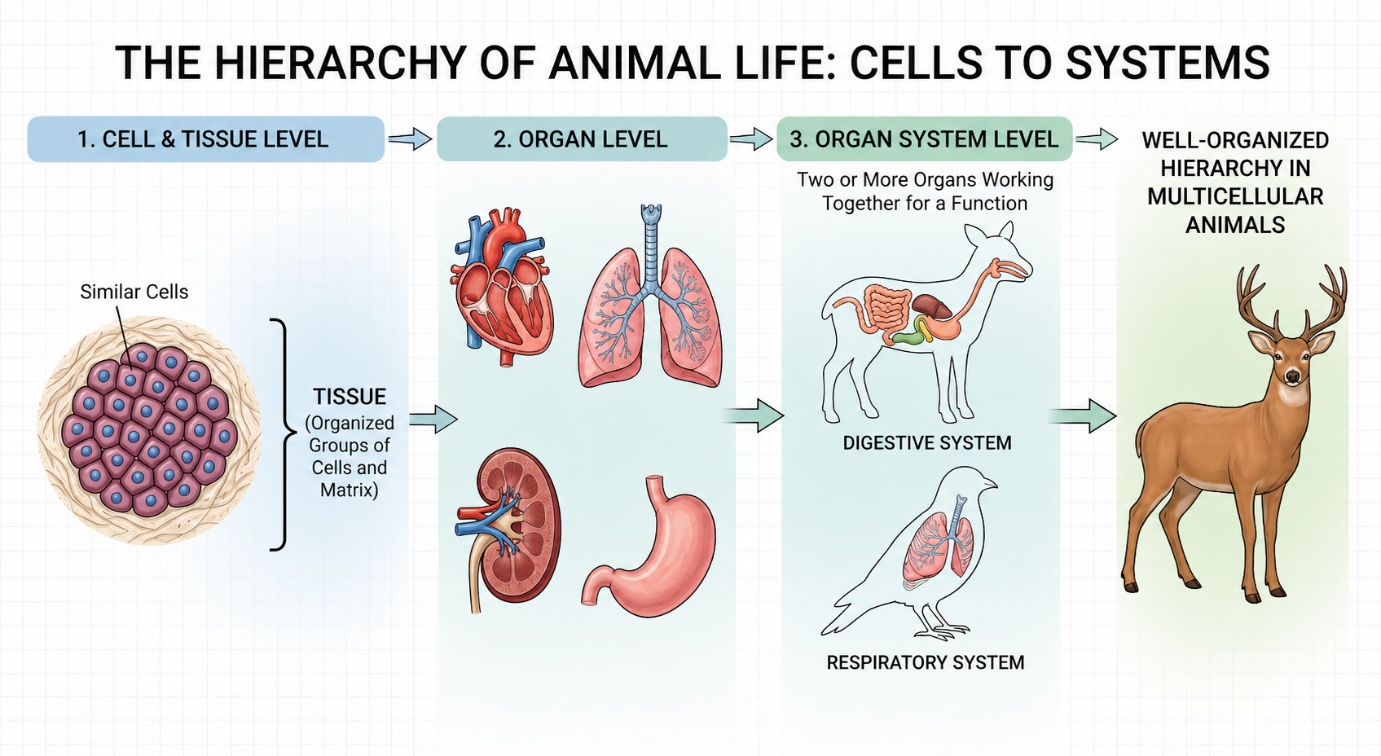
The Hierarchy of Animal Life: Cells to Systems
NCERT Reference Diagram: Progressive structural integration from microscopic cells to complex organ systems and organisms.
Interactive Levels of Structural Organisation
Fundamental Structural Unit
In unicellular forms (Amoeba), one cell handles all vital tasks. In multicellular animals, billions of cells specialize.
The 4 Foundational Animal Tissue Lineages
Epithelial Tissue
Primary Role: Protection, Secretion & Absorption
Closely packed cells, free surface facing fluid/air, minimal matrix.
Connective Tissue
Primary Role: Binding, Support & Transport
Most abundant; cells secrete collagen/elastin fibres and matrix (except blood).
Muscular Tissue
Primary Role: Contraction & Body Movement
Elongated fibres with parallel myofibrils; voluntary & involuntary classes.
Neural Tissue
Primary Role: Impulse Conduction & Control
Excitable neurons transmit action potentials; neuroglia form >50% of volume.
The Four Basic Animal Tissues
In complex animals, cells are specialized to perform different functions. Groups of cells with similar structure and specialized functions are organized into different types of animal tissues. Each tissue has structural features that are closely related to the function it performs.
In complex animals, animal tissues are broadly classified into four fundamental types:
- 1. Epithelial Tissue:Forms protective outer coverings and inner linings of organs, cavities, ducts, and tubes. Provides protection, secretion, and absorption.
- 2. Connective Tissue:Most abundant tissue; binds, supports, cushions, and transports substances throughout the organism (e.g., bone, cartilage, blood, areolar, adipose).
- 3. Muscular Tissue:Excitable, contractile tissue composed of muscle fibres that contract and relax to facilitate body movement and posture maintenance.
- 4. Neural Tissue:Specialized for sensing stimuli, rapid transmission of electrical impulses, and processing environmental changes (neurons and neuroglia).
All complex animal organs (such as the stomach, heart, lung, and kidney) are constructed from specific proportions and arrangements of these four basic tissue lineages.